Reginal Moore
Organist 1952-1957
A Centenary Tribute to Reginald Moore
by Christine Ford

Reginald Moore, at the left end of the adults on Cantoris
On the face of it Reginald Moore was a charismatic and larger-than-life figure, possessing great charm and a huge talent. Standing at over 6ft 4ins he had the presence and sparkling wit to ‘make’ any gathering. However, there was also a shy side to him and he often felt himself to be awkward with people and situations with which he was unfamiliar. He lived music every moment of his day and regularly embarrassed his daughter by beating time to whatever was in his head whenever they went for a walk together.
He was born 100 years ago in Bramley, Leeds on 19th May 1910, the eve of the funeral of King Edward the Seventh. Both Reg’s father and grandfather had fine baritone voices and sang as soloists in oratorio in Yorkshire. It was no surprise that he became a chorister at Leeds Parish Church at the age of seven. It was to be a long stint as his voice did not break until he was well over sixteen.
By this time he was also an award-winning pianist and was taking organ lessons with the legendary Sir Edward Bairstow at York Minster.
Reg won an organ scholarship to Peterhouse, Cambridge, but in the days when scholarships bestowed honour rather than money. The finances required for such a venture were beyond his family and instead he started teaching the piano and organ, and became organist of St Peter’s Church, Bramley. He continued his lessons with Sir Edward, taking the ARCO examination successfully at the age of 19, and following that with the fellowship a couple of years later.
Appointed in 1933 as assistant to Sir Walter Alcock, the organist of Salisbury Cathedral, the Yorkshire boy moved south to that most sheltered and peaceful of southern cathedral cities. He often talked of his home sickness in his early days, longing for the grit, lights, noise and energy of Leeds on a Saturday night as he wandered through the quiet streets of Salisbury. But it was here that his great love of choral conducting developed and was nurtured, becoming the most important aspect of his musical life for the rest of his days.
In his early years at Salisbury he met Sir Adrian Boult, who took a great interest in him, and was convinced that Reg would make an outstanding orchestral conductor. Generous in his support, his tuition, and in his introductions in London, he failed to persuade Reg that this particular rostrum was for him. Reg returned to Bramley in 1939 to marry Gay in St Peter’s Church. Within six months war had been declared, and early in 1941 he left Salisbury to serve in the Royal Air Force. He was trained in radar and stationed, for a large part of the war, at Bolt Head in South Devon.
At the end of the war he returned briefly to Salisbury, but was very shortly appointed assistant director of music at Winchester College. With its unique choral tradition, and with an abundance of very bright and able students to teach, he spent some of his happiest years here.
He revelled in the sophisticated badinage of the common room, and in living in such a vibrant and busy community. Firm friends with the cathedral organist, he also performed regularly there as well. It was at this time that he took his B.Mus degree externally from Durham University.
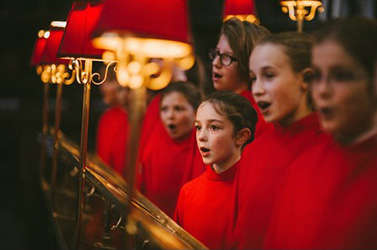
In 1952 Reg was shortlisted for the organist post at both Canterbury and Exeter Cathedrals. The Exeter interview was first, and he was immediately offered the job, having secured the vote of the choristers at the rehearsal he took with them. Finally he had his own choir, and he was determined that it should be second to none. He worked both himself and the choir tirelessly, and within six months the Exeter Cathedral Choir was being talked about in many important musical circles. His belief that only the very best performance was acceptable to the Glory of God sometimes made him a hard taskmaster, although he continued to inspire great respect and affection from the cathedral choristers.
The next few years saw many accolades with broadcasts and outside performances ahead of their time, as indeed perhaps Reg was a man ahead of his time for Exeter, still emerging from a tough war. For example, his espousal of the music of Herbert Howells caused visible discomfort to one member of the Chapter. Soon after his appointment to the Cathedral he had also been appointed Director of Music at the then University College of the South West (soon to become Exeter University). He also trained and conducted Exeter Choral Society and Orchestra. The workload was heavy, especially as for much of the time he had no assistant organist.
Disagreements developed with the cathedral authorities, and these could not apparently be rectified. After four years of glorious music-making, during which time he had introduced and also commissioned uplifting music, Reg left the Cathedral to concentrate on his university
work. Reg trained and conducted the University choral society and chapel choir, and continued as a recitalist, giving frequent broadcast recitals on the organ, and guest conducting the BBC Chorus.
At a farewell reception at the Cathedral he said “I am sentimental enough to believe that the music which we have made together in this wonderful Cathedral has been absorbed into these hallowed walls for all time”.
Reg died of lung cancer just after his 58th birthday in 1968. Sadly, he did not live long enough to know his two wonderful grandsons, but he would have been delighted that the younger became a chorister in the choir of one of his own Exeter choristers, at Rochester Cathedral.
(Reprinted from the ECOCA Newsletter 2011)