
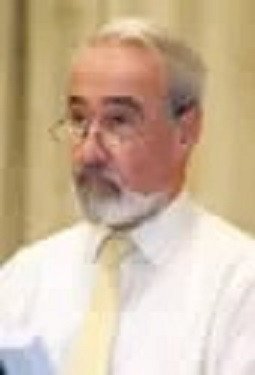
Geoffrey Mitchell
(6th June 1936-27th June 2026)
 Some Rambling Jottings of an Old Chorister (1944-1950)
by Geoffrey Mitchell
In about 1985, the Headmaster Harry Potts invited me to give a talk to the choristers about my own experiences in the late 40s. It seemed to me then that the boys were far more interested in the extraordinary daily routine than in the music itself - not surprising since the latter hadn’t really changed all that much. But, my goodness, the school most certainly had.
Wartime bombing and the blitz had made life in London very difficult, and my parents had hoped to get me off their worried hands. Exeter was as far from London as we could envisage, and it was here that I came at the age of 8 years and 1 month in August 1944. At that time, the school was still evacuated to Honiton, where it been most of the time since the old choir school was destroyed in the Baedeker raid on Exeter in April 1940.
The house – Holyshute – was a fine large 19th century premise, which with the addition of a couple of temporary wooden classrooms served the 26 boys of the school very well. There were just 20 choristers and 6 probationers in all my six years there. I spent only one term there before we moved back into Exeter to The Chantey, an ex-Deaconesses’ home, in January 1945. My memories of Holyshute are entirely happy ones. There was a large garden with a pond, in which, as I recall, there was small rowing boat! Also at the edge of the “playing field” was a huge chestnut tree, and if there were a shower during a game, we all sheltered under this tree and partook of all the windfall fresh chestnuts. Nothing had ever tasted so good!
Talking of food, we were very lucky by living in the country, and also from having a very kindly and skilled cook. She retired soon after we came to The Chantry and things were never so good afterwards! She would bake, make jam, stews and I certainly had never eaten so well in my life after the privations of a ration-ridden regime in London, where one was permitted 1 egg, 2 ounces of sugar and 2 ounces of cheese per week. Meat had been very scarce, and our mothers had to make the best of spam, whale meat and powdered egg.
The choristers went into Exeter a few times each week to sing the services, but the probationers only joined them on Saturdays and – in our Eton suits – on Sundays: Evensong only on the Saturday and all the services on the Sunday. Cook always made up a spectacular hamper for our lunch. There were the most authentic and delicious Cornish pasties, fruit and a huge fruitcake, the like of which I had never seen in my life. We ate this in the Cloister Room (now appropriately enough the Refectory).
Christmas 1944 was my last one at home until 1950! The terms in those days were inordinately long. The school holidays were taken after the main religious feast, and the choir stayed in residence until Epiphany, being allowed to travel home on the evening of January 6th if there were suitable trains. Otherwise we stayed another night! It’s worth noting that in all my six years we had only three boys from Devonshire: boys came from all over the country – Scotland included! The Christmas holiday was exactly 2 weeks and four days. Similarly we stayed after Easter to sing the whole of Easter week, up till Low Sunday, when again we were allowed home for 2 weeks and 4 days. The summer holiday was exactly the month of August. There were no half-terms (I don’t think they had even been invented at that time) and only two exeats (for tea only) were allowed per term. Luckily we were allowed to go out with others, and I well remember John Lomax inviting me to join him and his parents for tea – occasionally driving as far as Teignmouth! In my case, my mother came only twice in all my six years. Once with my father, for my Installation in the May of 1945, and then with my Godmother for my confirmation in October 1948, after which we went with our folk to tea with the Bishop of Crediton who had confirmed us.
The move to The Chantry was a reawakening. The food was far worse than anything I had ever eaten. We were obliged (I can’t really say forced, though that is what it felt like) and under constant supervision, to eat everything that was served. I well remember very gristly meat, and eternally brown cabbage. Due to financial restraints, we had only one maid/cook, and the boys were responsible for all the table-laying, the clearing, the washing up and drying up at every meal. The head boy had to create a roster at the beginning of term for this to run smoothly. But I say “Thank Goodness”, because under the refectory table, at which 20 of us sat to eat, there was wooden ledge. When Mrs Treneer wasn’t looking we would pass the totally inedible bits along, where it was surreptitiously placed on this ledge. The table-clearers then rescued all this debris into an Ostermilk tin and it was deposited down the well in the back yard. I dread to think what happened down there after all those years of putrefaction, and whether it was ever discovered!
Remarkably we all survived – largely on unlimited bread I recall, though butter was restricted to Sundays only. Notably the staff did NOT eat with the boys, but in a private dining room, and on occasions one or two of us would be invited to clear up after them. The delicious roast potatoes, and buttered scones, and all manner of exotic tit-bits, which we consumed hurriedly and heartily during this exercise, almost made up for the previous deprivations! Although strictly against the rules, the late Bob Norman, who happened to be the only chorister I remember who actually lived in Exeter – on Pennsylvania – used to sneak us up to his mother’s for tea and cakes on the afternoon walk after Evensong! And also the aforementioned John Lomax had an aunt who ran the local Workhouse (yes there still were such things) and we would go there for a similar treat!
Reading Dickens later in life, I realised that very little had changed during the century after he was writing! I ought to spend a moment describing the working day. We sang Matins and Evensong every day except Wednesday (and Saturday when Matins was said). Our day consisted of the walk in crocodile; breakfast; choir practice; matins; TWO school periods; lunch; ONE period; evensong at 3pm; walk about town in pairs; tea; psalm practice for the following day; prep; bed! It has never ceased to amaze me how we all managed to achieve scholarships to our chosen schools on 3 periods of academic work a day. I suppose it was the almost one-to-one nature of the teaching with so few boys. On Wednesday, Matins was replaced with another lesson, but the afternoon one was lost to sport. Saturday morning’s Matins time was occupied with gym at the Episcopal School, where Mr Treneer had been Headmaster before coming to us.

Geoffrey, as Head Chorister, presents Princess Elizabeth with a gift during her visit to the Cathedral, 21st October 1949. Geoffrey was Head Chorister for two years; holding the office for this long may be unique. This visit by HRH took place in his last term. He can still remember what he said to HRH: "Will your Royal Highness be pleased to accept this little gift, made by one of our own workmen, out of old Cathedral stone?". (information from Geoffrey Mitchell, March 2021) (more information about this photo)
Memory is a strange thing: so much of our life was variedly unpleasant, but the Cathedral and the music made up for everything, and it is due to those wonderful facets that we come streaming back to relive the best part of our chorister days year on year. While writing this I have been aware of so many details of the musical life which impinged on all this.
“A.W. Wilcock.
D. Mus. (Manchester); B. Mus. (Durham);
F.R.C.O., F.R.M.C.M., Hon. R.C.M., L.R.A.M.” (Poor fellow!)
Thus did Dr. Wilcock, affectionately known as Baldy, sign my autograph album.
Dr. Wilcock conducting
I barely recall my audition in the Autumn of 1943 in the Organist’s flat in Church House. But it would have been with the good Doctor, a benign figure, whom I remember telling to play my choice of piece - the hymn Fight the good fight, to the tune Pentecost, “beginning on C sharp”! As if there were a choice, but my mother had given me strict instructions to request it thus (he often referred to it later on...)
He had spent three years as Organist of Derby Cathedral before succeeding Thomas Armstrong, who had been promoted to Principal of the Royal College of Music. At the age of 46 he was appointed as Organist of Exeter in 1933, retiring in 1952 due to ill health. He died the following year. On account, no doubt, of this ill health (partly I fear exacerbated at The Royal Clarence) the choir was honestly not very good throughout my time here. I well remember us often breaking down completely in unaccompanied Tudor settings, and Baldy having to clap his hands, blow another note on his modified organ pipe, and say “back to He hath out down”, or whatever... Sadly, we didn’t seem to be particularly embarrassed. He was unfortunately too ill to put in any appearance at all over my last Christmas (1949). The choir climbed the stairs to the door of his flat and sang him carols though the open door. Choir practices were little more than sing throughs as far as I recall, and Baldy could easily be distracted to play Grieg’s Wedding Day at Troldhaugen for us!
A couple of years earlier he had surprised us all by remarrying a Miss Gadd (Baldy was a widower) who became a particular favourite of all of us, giving the odd tea party, which was in those straitened times a huge treat. Staffing cathedral choirs during the war must have been difficult, and our six Vicars Choral remained pretty stable as a group throughout most of my six years. Mr Plowman retired from the alto line to be replaced by Mr Judd; Mr Kennedy died in office. Otherwise the team consisted of Messrs Thomas, Isaacs, Tapley and Dineen.
Kennedy’s funeral was the first I had ever attended – his stall looming empty during the service, with his surplice and mortarboard draped over the music stand. Dr Wilcock played the grand piano instead of the terrible temporary organ that was in the nave, and played the Chopin Funeral March so beautifully that I think we were all in tears by the end. It seemed to us then that the piano was his better instrument.
Services were held in the nave until the Quire was re-opened on Easter Day 1948, with the restoration of the Organ from its hiding place for the duration of the war (likewise the East Window and the Bishop’s Throne). The asbestos wall at the Crossing was removed and the glories of the Quire came into view. There were semi-permanent stalls in the nave, together with the temporary organ. But I seem to remember the piano being used in preference.
There were still musical highlights: the Grandisson Service on Christmas Eve; carols from the Minstrel’s Gallery at the end of Christmas Evensong; the termly oratorio performances with the Musical Society; orchestra and visiting London soloists. I still have the autographs of then famous singers like Heddle Nash, Eric Greene, Ena Mitchell and George Pizzy.
One of my greatest musical memories was quite unconnected with the cathedral, occurring during my last year when I was Head Boy. During Prep one evening Mr Treneer came into the form room and called me out. We walked along Queen Street to the Corn Exchange, where a short word with the lady on the door admitted us to a recital by none other than Solomon, one of the greatest pianists in the world at the time. I remember my parents being envious beyond words when I wrote and told them!
Which brings me to the Treneers. Howard Treneer was Head of the Episcopal School, and was appointed to the Choristers’ School as we moved back into Exeter to The Chantry in January 1945. In order to follow protocol he was invited to take Holy Orders. Something of a polymath, he taught everything, and was no mean cricketer. I think everyone had nothing but kindly thoughts for Pa Tren, hardly ever showing any signs of disapproval. Never seen without his pipe, he would frequently ask one of the boys to pop round the corner for an ounce of Digger Shag – his favourite tobacco! Those were the days!
Unfortunately Mr Treneer came with Mrs Treneer. It may just have been that she didn’t like me. An upstart oick from Essex probably wasn’t her style! But I found her disingenuous to put it mildly. Amongst the Assistant Masters the most long-standing was Keith Gibb. He had two canes, Little Willy and Big Willy, the former being by far the most painful. He was not loath to use them frequently for the smallest misdemeanour, including during Saturday Latin tests!
Visiting staff included the lovely Mrs Pamela Michelmore, who taught us Geography on a Saturday morning. She marked our books with the first red Biro we had ever seen, it being fairly newly patented by Mr Biro in 1938! But we were forbidden to use them, having to stick with pen-nibs and inkwells! As I conclude this excavation into the depths of my memory, all the trials of school are obliterated by the music and the atmosphere generated by those two hours in the Cathedral every day. As with so many of us, my career was formulated there and then.
I was persuaded by the Secretary and Simon Swan over a post-ECOCA committee meeting pint to put down some of my recollections about the early days of the Exeter Old Choristers' Association.
Before I go into any detail it is interesting to recall that in my last year (1949) Mr Treneer gathered the three prefects together to discuss the possibilities of forming just such an association. And although we boys had little idea of how it might work, I can well recall that we – even then – decided that the most effective day would be Easter Monday. For not only would the Cathedral choir still be in residence (in 1949, remember, we sang full Cathedral services through to, and including, Low Sunday!) but also schools and universities would be on vacation and the general workforce enjoying a Bank Holiday. All in all a perfect solution and so it has remained to this day. It is hardly surprising that we at Exeter enjoy one of the largest turn-outs in The Federation for our annual reunion.
Alas nothing came of the idea for another fifteen years. By way of salvation came Marcus Knight from St Paul’s as Dean, and his appointment of Lionel Dakers to the organ loft, and the remarkable and charismatic new Headmaster in the person of Tom Evans, who quickly restored both the school’s finances, and more importantly, its reputation. It is to these latter two that we owe our existence.
I was singing at St Paul’s myself when my attention was drawn to an advertisement in the national press for old choristers of Exeter to make themselves known to the school, with a view to founding an Old Chorister Association.
A committee was assembled and an inaugurative meeting was held in the Cloister Room on April 21st 1964, with the Headmaster as Chairman – a situation which prevailed until Christopher Hellier thought it more appropriate that we should appoint a Chairman from amongst our own members. The committee consisted of a wonderfully eccentric (or so it seemed) and charismatic Edgar Herbert as Secretary; Frank Cotton, Treasurer and also John Baker, Howard Crawshaw, and a Mr R M Brown. Alas none of these is still with us, but they were a very forward-looking bunch. Immediately they sought membership of the Federation on the suggestion of Geoffrey Timms, and very soon began talking about a Benevolent or Bursary Fund.
This may be the opportunity to stress that for an Old Chorister Association to thrive, it must have the enthusiastic support of both the Cathedral Organist and the Headmaster. I have seen far too many in the Federation struggle without those vital factors. We have been particularly fortunate at Exeter, for both Lionel’s successors – Lucien Nethsingha and now Andrew Millington – have been immensely keen to welcome us and, most importantly, to encourage us to sing. And among the significant early Headmasters to be thanked must be Ian
Watson, Harry Potts who went on to Westminster Abbey Choir School, and Christopher Hellier, leaving to found the first Cathedral Girl’s Choir at Salisbury.
However this article is not the occasion for a comprehensive history of the Association. This is a personal recollection of a few of my own experiences as I remember them.
A newsletter arrived from Herbert in the September 1964, which I still have, and we were encouraged to subscribe to a dinner the following Easter, 19th April, 1965. The following March saw the arrival of a postcard from him (again which I still possess!) urging us all to attend. I cannot remember how many people were there though we made a substantial contribution to Walmisley in D minor and Blessed be the God and Father, so I think there were perhaps thirty or forty of us.
I arrived a little late (my London duties prevented me from getting there earlier) and as I approached the golden gates I heard this tremendous sound emerging from the Choir and was honestly rather terrified and – yes, shy - of entering. But Michael Hagyard saw me hovering from his place in the stalls and waved to me to join him! It was a most uplifting occasion, and I suppose we can say history was being made. (But actually we were only re-making history, as Stan Packman in his researches in the Cathedral archives during the ‘80s found reference to old choristers’ dinners in the early years of the 20th century – so I presume the First World War was responsible, as with so many other institutions, for its demise.)
After dinner at the Rougemont hotel there was a brief AGM, and that pattern continued for a few years before it was thought more fitting to meet immediately after Evensong and enjoy dinner afterwards. The production of a Tie was proposed at that first meeting. It was also proposed that John Lomax join the committee which he did for a while, and it is particularly pleasing that we now see him regularly again.
I was unable to attend the second reunion as I had to fly to Prague on a Radio 3 assignment – the only meeting I have ever missed! For purely financial reasons the 1966 dinner was held at The Chevalier Restaurant (appropriately enough with a Knight as our Dean) and the AGM was chaired by Frank Cotton as the Headmaster was not available, and the Secretary too ill to attend.
Alas we lost our energetic Secretary during the early months of 1967 and a Memorial Service was held for him on February 28th. At the Easter Monday 1967 reunion Frank Cotton was elected Secretary and Treasurer, posts he served with enthusiasm and aplomb for a great number of years. It was also announced that we had been accepted as official members of the Federation, of which Edgar Herbert would have been so proud.
At that ’67 AGM it was decided to invite the 6 senior choristers to the tea, and for Old Choristers to read the lessons. It’s wonderful to see how far back these traditions were established.
The dinner venue has changed over the years, as fewer places were able to staff a dinner on Easter Monday. For some years we ate either at The Clarence or at the White Hart. On one occasion through desperation the dinner was at the Red Cow (or some such name) – a burger cafe on North Street. I remember the Dean sitting at a small round plastic table amongst the ketchup bottles officiating over the proceedings. Not a highpoint of our annual meetings! But we survived.
Another occasion is memorable, again for all the wrong reasons. We arrived in Exeter on the Monday morning to find Frank Cotton in a rare state of panic. He had gone to the Chevalier restaurant with the final tally of numbers for the evening dinner to find it bolted and barred, with, on the door, notice of liquidation of the company. Here was he, with 60 or 70 people coming to dinner on a Bank Holiday Monday with nowhere to take them and no food for them to eat! By some miraculous means he contacted a catering company and found furniture for us all so that could use the Chapter House. Solution of a sort, but the Chapter House was unheated in those days, and the air, as well as the food by the time it reached the tables was stone cold, and while the white wine may have benefited, the red was virtually undrinkable at that temperature. But we survived - again!
In 1978 it had been thought an attraction to the younger members if we contracted the reunion into one single day, and hold our official meal after Eucharist - at lunchtime, the Chantry providing the premises. This was fine as far as it went, but unfortunately the Secretary also arranged an evening dinner for “the over-18s”, which I severely criticised as being the very sort of elitism we were seeking to avoid. If the younger members were specifically NOT invited to everything they would stop coming was my argument. And I took a few off to a restaurant in protest! At least it didn’t happen again!
As soon as 1969 the Bursary Fund was established and a Constitution agreed. In the early ‘70s it was proposed that we host a Federation Festival in 1975. But as the years drew nigh it was realised that we
simply hadn’t prepared well enough, and sought to swap with Sheffield who were down for 1983. Luckily they agreed and so it was that we held a most successful festival - our first – in that year. Subsequently we saw out the last millennium with our second festival in 1999, and are now committed to 2015 – the year after our Golden Jubilee. I think we all need to think hard and deep about what we can do to contribute to the proceedings! To those of you who haven’t attended, the annual Federation Festivals are great fun and a huge opportunity to show the world what we do – and how well we do it!
One of the highlights of our existence must be the Silver Jubilee celebrations in 1989. Our Chairman, Nick Pedlar, went to enormous pains to make it a special occasion. Sponsors for Champagne, for flowers and for engraved wine goblets were sought and found. Invitations to other Associations elicited a handful of their representatives, and a dinner dance at The Rougemont capped the proceedings. I commissioned a special anthem from Richard Shephard, who’d been an old singing pupil of mine, – The Strife is O’er – which is still sung regularly at Eastertide. If our Golden Jubilee is anything like so successful, we are in for a treat!
Recent years have seen small but significant changes in the dinner pattern: the Exeter Motel, the Golf Club – very good but a bit expensive – St Olave’s which attracted great approval. As in the ‘60s a Bank Holiday Monday is not an easy time to arrange large dinner functions due to the difficulty of hiring staff, and we are extremely grateful to those members of the committee who spend a lot of time and trouble seeking the solutions. I think we all agree that for all the heartfelt nostalgia of singing again in our own alma mater, the camaraderie of the dinner must remain the highlight of our day, and it is important that we get it right. Those early pioneers in 1964 got it right from the very start and we owe it to them to continue the good work. Viva ECOCA!
Reprinted from ECOCA Newsletters for:
More information about Geoffrey's professional music career.